There’s a particular kind of laziness that creeps in after years of shooting with a zoom. You plant your feet, you twist the barrel, and you convince yourself you’ve explored a composition. I’ve done it in the Cascades, I’ve done it along the Oregon coast, and if I’m being honest, I’ve done it enough times that I started coming home with technically fine images that felt somehow hollow. The zoom lets you solve compositional problems from where you’re standing, and that’s exactly the trouble.
In this Nigel Danson tutorial, he takes an 85mm f/1.8 prime into the Lake District for a full day of landscape shooting and documents what changes when you remove the option to zoom entirely. Watch the full tutorial on YouTube before or after reading this. What he finds isn’t just a fun experiment. It’s a genuinely useful reminder of how we learn to see in the first place, and why photographers of every level should periodically force that reset.
I still shoot film occasionally for exactly this reason. A 36-exposure roll with a fixed 50mm makes you think before you press the shutter. The prime lens challenge Danson walks through is the digital equivalent of that discipline, and the Lake District footage makes the lesson concrete enough to carry back to your own location.
Step 1: Choose Your Focal Length and Commit Fully
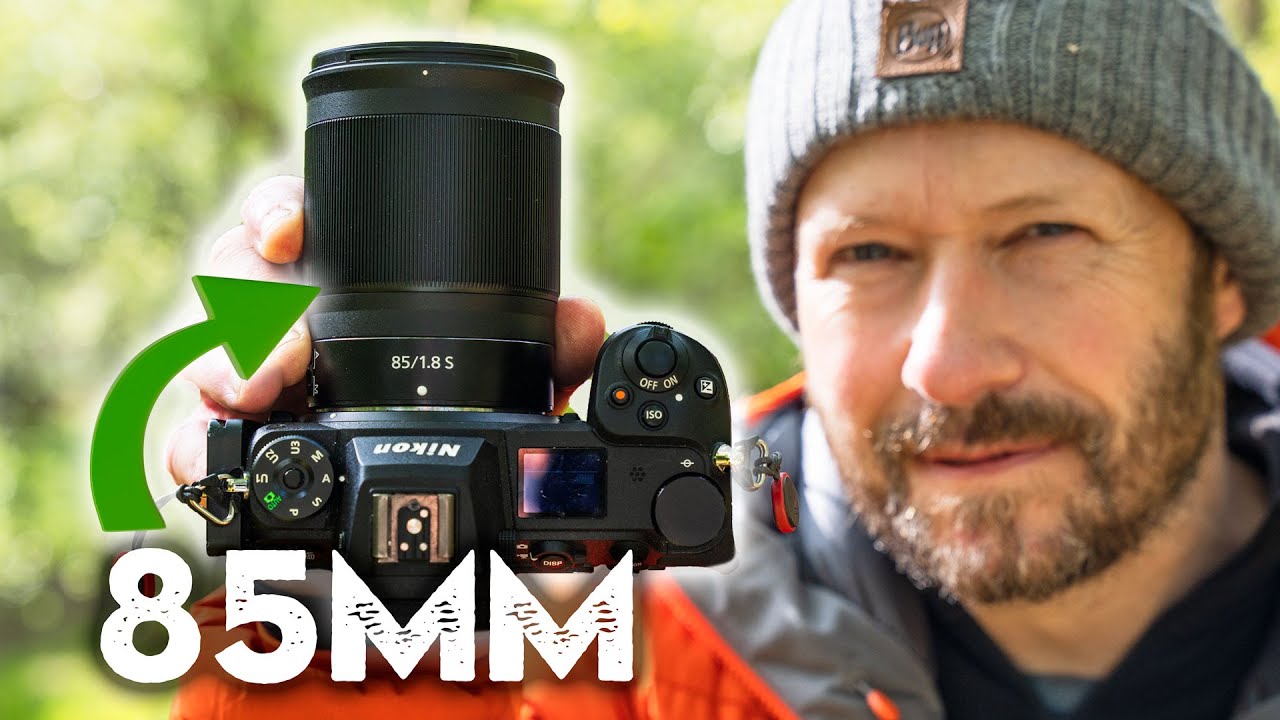
 Danson holding camera and 85mm prime lens outdoors
Pick one prime and leave everything else in the bag. Danson goes with an 85mm f/1.8, a focal length that compresses the scene slightly and excels at isolating subjects within a broader landscape. For woodland or lone tree work, it’s a strong choice. If you’re new to this, a 50mm is a more forgiving starting point. The key is that you make the decision before you arrive and you honor it. Don’t bring a backup zoom and tell yourself it’s just in case. That safety net will undermine the whole exercise.
Danson holding camera and 85mm prime lens outdoors
Pick one prime and leave everything else in the bag. Danson goes with an 85mm f/1.8, a focal length that compresses the scene slightly and excels at isolating subjects within a broader landscape. For woodland or lone tree work, it’s a strong choice. If you’re new to this, a 50mm is a more forgiving starting point. The key is that you make the decision before you arrive and you honor it. Don’t bring a backup zoom and tell yourself it’s just in case. That safety net will undermine the whole exercise.
Your only job for the day is to learn what that one focal length does to the world in front of you. Everything else flows from that.
Step 2: Leave the Tripod as a Last Resort, Not a First Instinct
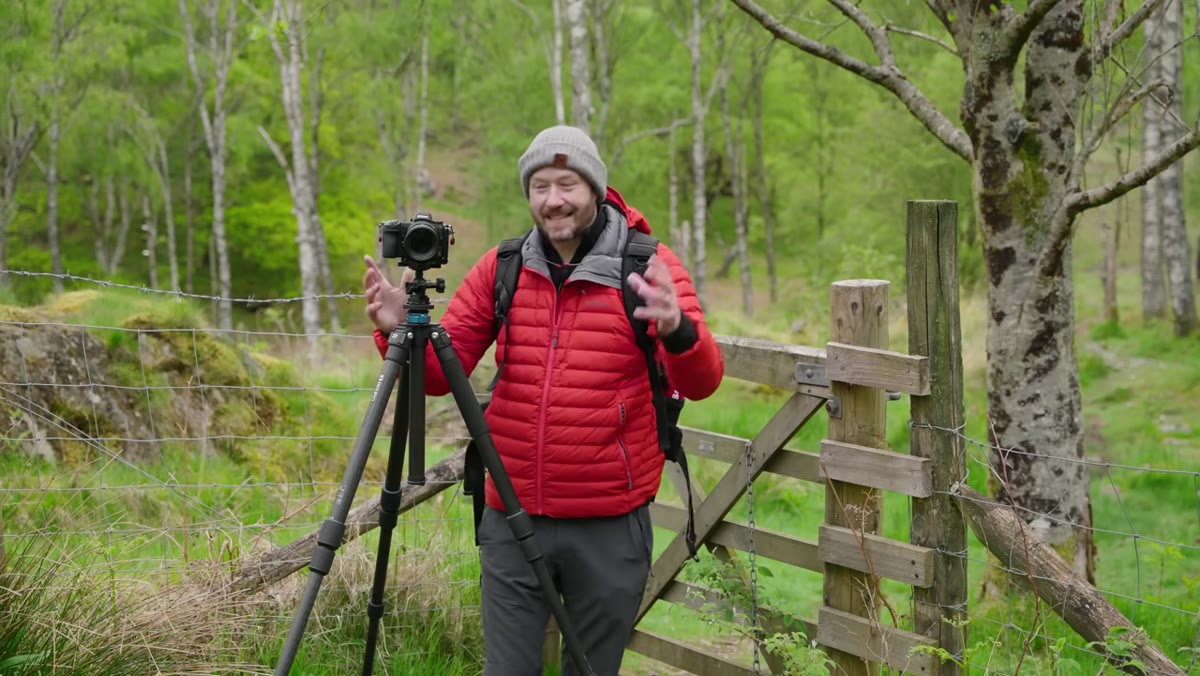
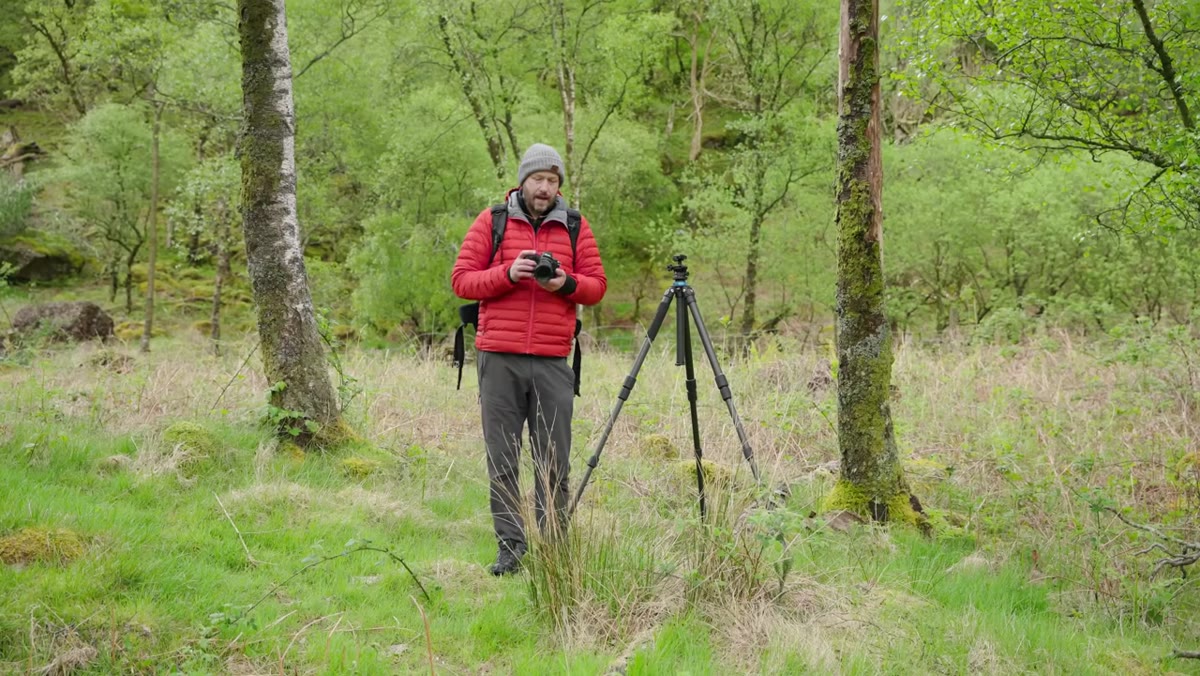 Danson walking and handholding camera through woodland
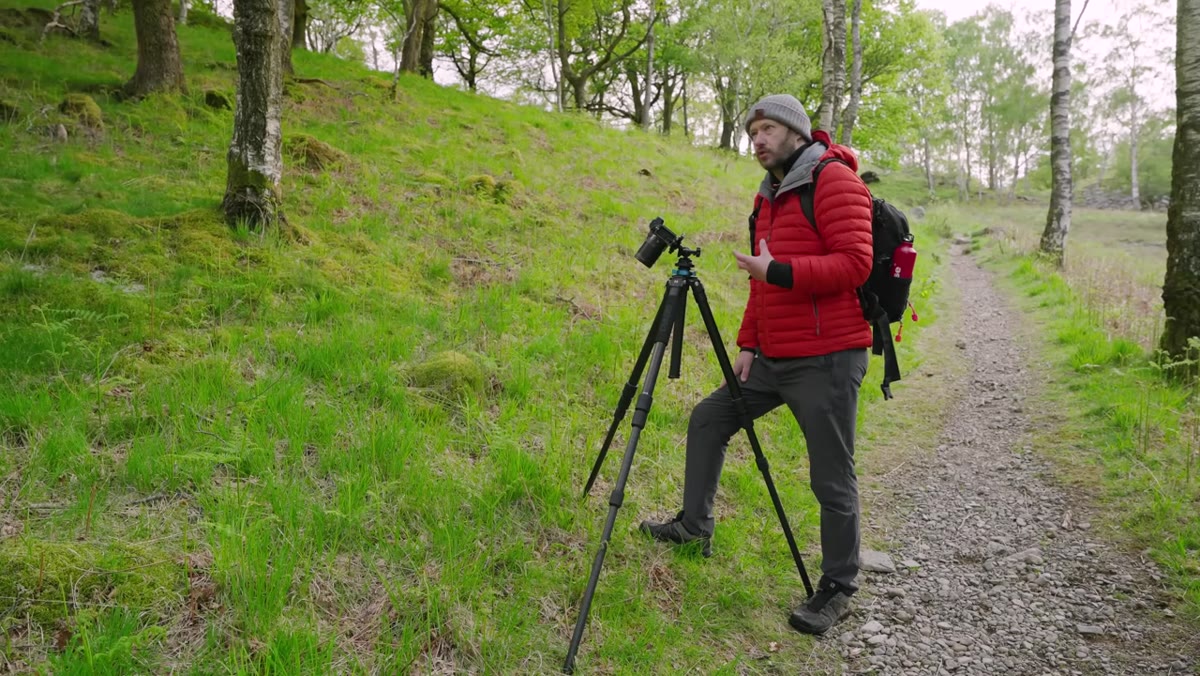
Danson is explicit here: bring the tripod, but resist it. He uses it only when shutter speed demands it, and the rest of the time he’s moving, looking, and composing handheld. This matters because the tripod creates a false sense of commitment. Once it’s up, you tend to stay put and work the frame from that single position. Handheld shooting keeps you physically mobile, which is the whole point of the exercise.
Danson walking and handholding camera through woodland
Danson is explicit here: bring the tripod, but resist it. He uses it only when shutter speed demands it, and the rest of the time he’s moving, looking, and composing handheld. This matters because the tripod creates a false sense of commitment. Once it’s up, you tend to stay put and work the frame from that single position. Handheld shooting keeps you physically mobile, which is the whole point of the exercise.
At 85mm you can typically handhold down to 1/100s and still get sharp results, depending on your body’s stabilization. In decent morning light, that’s usually enough. Keep ISO flexible. Getting sharp handheld frames at 800 ISO is better than a slightly blurry one at 200 because you refused to bump the sensitivity.
Step 3: Move Your Feet to Solve Composition Problems
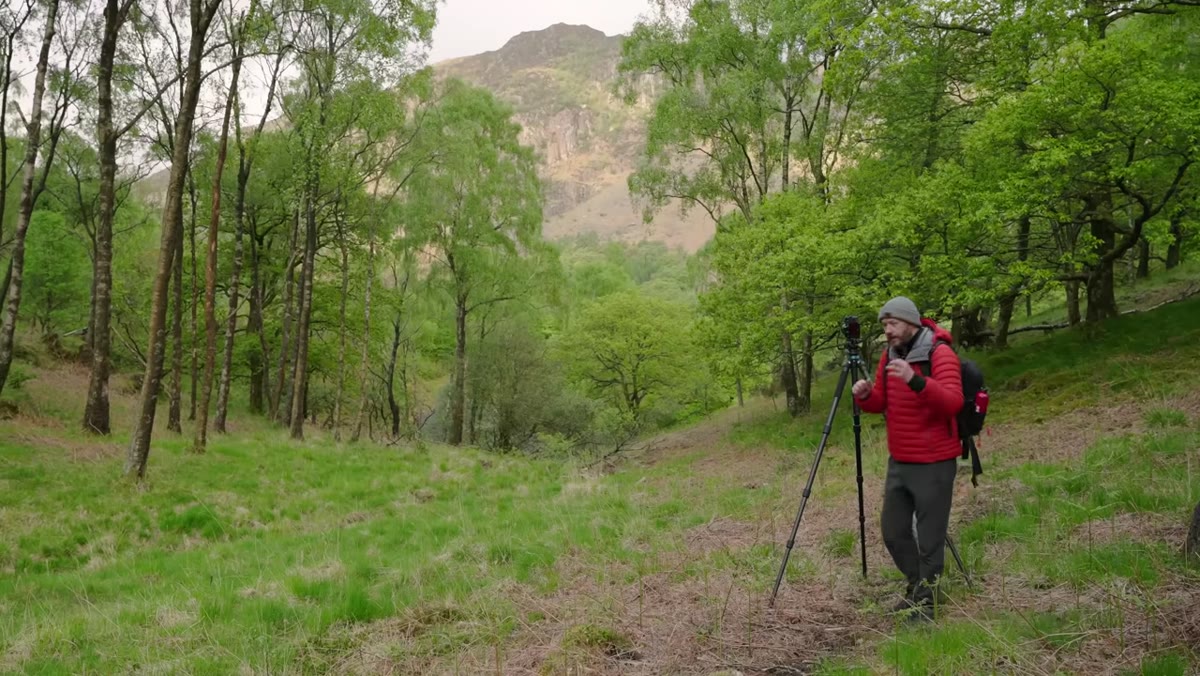 Danson repositioning to find a better tree composition
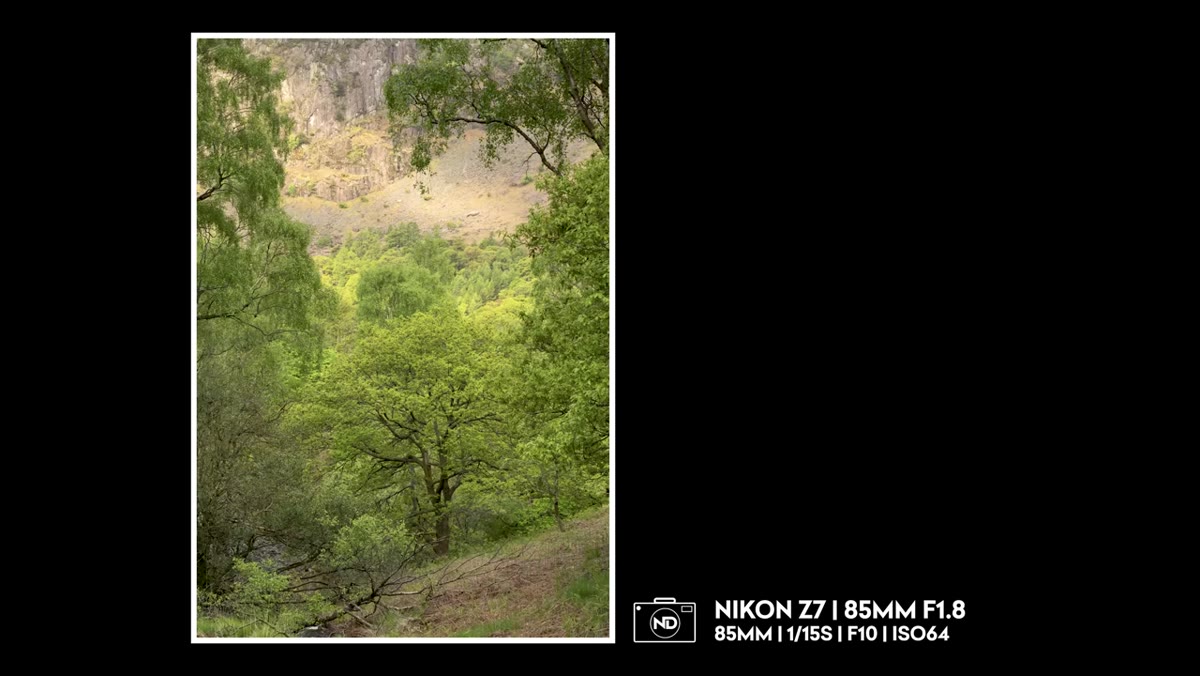
This is the core lesson of the whole video, and it’s the one that gets skipped most often. When a composition isn’t working with a prime, you can’t fix it by reaching for the zoom ring. You have to move. Danson demonstrates this when he walks from one position to another and gains elevation, which brings more foreground foliage into the frame and gives the mountain behind a tree more visual weight without needing to include its full peak.
Danson repositioning to find a better tree composition
This is the core lesson of the whole video, and it’s the one that gets skipped most often. When a composition isn’t working with a prime, you can’t fix it by reaching for the zoom ring. You have to move. Danson demonstrates this when he walks from one position to another and gains elevation, which brings more foreground foliage into the frame and gives the mountain behind a tree more visual weight without needing to include its full peak.
That cropped peak turns out to be an advantage. It leaves something unresolved in the frame, something that pulls the eye back. This wouldn’t have happened with a zoom because the easy move would have been to zoom out and include everything. Moving your feet forces creative decisions that the zoom would have made unnecessary.
Step 4: Let the Focal Length Shape What You Prioritize in the Frame
 Close composition of tree canopy tops isolated against sky
An 85mm on a landscape isn’t trying to show you everything. It’s asking you to choose. Danson finds a cluster of silver birch trees and uses the lens to isolate their upper portions, cropping out the base and surrounding clutter. The result is cleaner and more graphic than a wide shot would produce. This is the compression working in your favor.
Close composition of tree canopy tops isolated against sky
An 85mm on a landscape isn’t trying to show you everything. It’s asking you to choose. Danson finds a cluster of silver birch trees and uses the lens to isolate their upper portions, cropping out the base and surrounding clutter. The result is cleaner and more graphic than a wide shot would produce. This is the compression working in your favor.
Longer focal lengths stack visual elements in a way that wide angles separate them. Use that. Look for a single tree against a distant ridge, or a foreground element you can push into relationship with a background feature. With an 85mm, layers in the landscape start to feel connected rather than spread apart.
Step 5: Notice What You Would Have Walked Past with a Zoom
 Danson shooting downward at unfurling ferns on the ground
Here’s where the challenge becomes genuinely interesting. Because you’re not solving problems from a standing position by adjusting focal length, you start looking differently. Danson spots ferns just beginning to unfurl along the path and drops down to shoot them straight on. It’s not a grand landscape. It’s a small, quiet detail. But because the prime forces him to move and look rather than adjust and settle, he finds it.
Danson shooting downward at unfurling ferns on the ground
Here’s where the challenge becomes genuinely interesting. Because you’re not solving problems from a standing position by adjusting focal length, you start looking differently. Danson spots ferns just beginning to unfurl along the path and drops down to shoot them straight on. It’s not a grand landscape. It’s a small, quiet detail. But because the prime forces him to move and look rather than adjust and settle, he finds it.
This is the moment I recognize from my own work. When I’m shooting with constraints, whether it’s a prime or a roll of film or deliberately limiting myself to 20 exposures, I slow down enough to actually see the environment I’m standing in. The zoom encourages you to hunt for a composition. The prime encourages you to find one.
Step 6: Review What You Got and Notice the Patterns
After a full day with one focal length, sit with your images before editing and look for patterns. What kinds of compositions did you repeat? What distances did you naturally gravitate toward? What subjects did you find yourself drawn to that you might have skipped with a zoom? This review is where the real learning consolidates.
Danson doesn’t cover this part in the video, but it’s the step that makes the challenge stick. The day in the field teaches you something intuitive. The review afterward makes it conscious.
A Note from 20 Years in the Field
The mentor who pushed me hardest used to say the mountain doesn’t care about your schedule. He meant it about patience and weather, but it applies here too. The landscape doesn’t care which lens you brought. It doesn’t adjust itself to your focal length. You adjust to it, or you come home empty.
What I’ve noticed after running prime-only days in the Cascades and along the high desert of central Oregon is that my zoom work improves afterward. The discipline of moving to the subject, of committing to a frame before I set the tripod, carries back into regular shooting. You learn the zoom’s bad habits by removing it. That’s worth one uncomfortable day of constraint.
The single most important thing Nigel Danson demonstrates here is that most compositional problems are actually movement problems. The zoom is a convenience that hides that fact from you. One day with a prime, in a place you know well or somewhere completely new, will teach you more about your visual instincts than a month of comfortable shooting with a do-it-all lens.
Watch the full tutorial on YouTube to follow Danson through the Lake District and see the actual images the 85mm produced over the course of the day.
Comments (1)
This is exactly what I needed today. Been struggling with this for weeks.
Leave a Comment